8 vies pour la planète
Maison des Associations
Av. Saint-Exupéry - 13250 Saint-Chamas, France
contact@8vies.fr
Studying and communicating about the ecological and systemic functioning of the lagoon
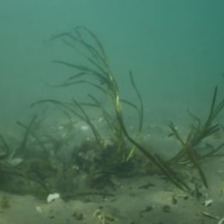
Certain areas of the Berre lagoon are silty deserts. Few species nest there. Soft bottoms prevent mussels and algae from taking hold. Currents tear up the few seagrass beds attempting to structure the floor with their rhizomes. Lacking food, the rare fish merely pass through. Only a few marine gastropods create burrows in these hostile environments.
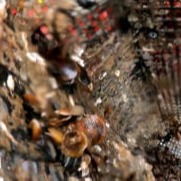
In 2022, as part of the ZoRRO project, we placed dispersing buoys at Saint-Chamas in a zone very poor in ecosystems. We observed that this buoy became a real oasis of life. The buoy, rocked by waves, was covered with a solid layer of mussels, sponges and algae. The small net in which we had enclosed some seagrass spikes had swollen with life — it now measures about 50cm in diameter and shelters around twenty species, including juveniles, worms and 3 crabs that grew inside the net.
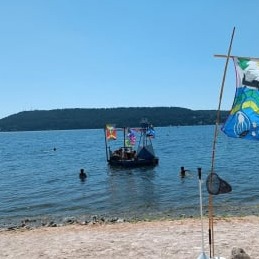
This observation gave us the idea of building a floating reef. We began constructing a floating platform, the "Ressentiscaphe", in 2019. We observed that a highly diverse ecosystem developed beneath it. In 2024, we moored the platform to a mooring provided by the Saint-Chamas marina.
The aim of the "Récif" project is to provide a development zone for lagoon ecosystems (surface, floor and intermediate zone), to study them and to communicate about the evolution of life in our lagoon.
Our outreach is carried out through the Nautile (a caravan at the port from May to October) as well as participatory workshops with local communities.
Consisting of a tower (for visibility) and a floating platform made of a wooden structure supported by containers. The floating section of the reef is much less susceptible to algae smothering, and also isolates nesting species from crawling predators — particularly the veined rapa whelk, an invasive species that feeds on molluscs on the bottom but cannot climb a chain to reach the craft.
We attach "habitats" at various levels of the water column to serve as ecological niches across different reef zones. The first clay habitats were made in workshops with young audiences. Other similar structures will be made with organisations wishing to participate.
A solid concrete mooring (deadweight) serves as anchorage. Stones, bricks, pottery and other solid elements are also deposited. Seagrass anchors and flat oyster spat will also be introduced here (Sergent Garcia project). These three parts each play their role in the ecosystem, housing different and complementary species, providing habitat for juvenile fish throughout the year.
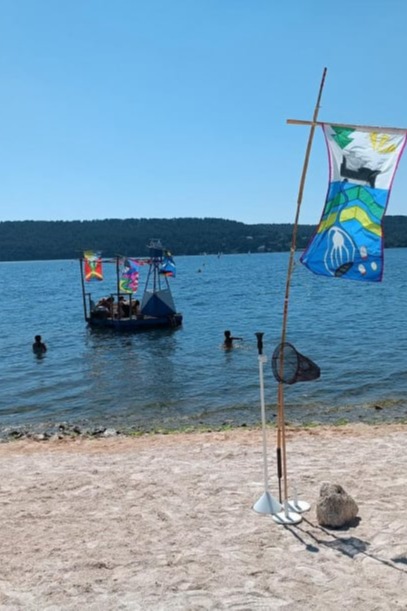
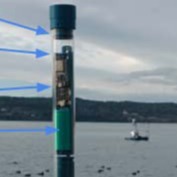
We take measurements of temperature, surface state and turbidity.
We are setting up a photographic capture process to visually monitor ecosystem development. We are testing bamboo as a structural material and float to replace plastic containers. We will build a new platform in 2025 based on experimental results, allowing us to observe biodiversity development from scratch and correlate it with temperature, salinity and turbidity data. We are developing an automated sensor capable of measuring these parameters (see the "Lagoon data project" page).